Showing posts with label Farming. Show all posts

Friday, September 17, 2010

Aren't We Farming Yet?


We planted coffee before we knew what we were really doing. It fit most of the criteria we had for a crop we wanted to focus on:
Long-term orchard type crop
Not too intensive to care for
Plants and land-preps for them relatively inexpensive
 A few other crops that are grown around here may have very good returns but also demand huge labor costs and other expensive inputs (fertilizers & pesticides) in a short period of just a 3 or 4 months.
 
 Actually those first 50 coffee plants were free volunteers that we got from a neighbor. As a newcomer to the tropics, these seemed like an exciting, exotic crop to me, which made them just a little bit more alluring to get involved with. Later on I discovered the local wholesale value for the finished, un-roasted beans, plus the amount of post-harvest work it takes to get them to that point, and the attraction began to fade. Plus, coffee plants take 3 years to begin to bear reasonable sized crops; they’re still far from fully mature. Marketing directly to coffee consumers in the U.S. rather than one of the corporate buyers here, like Nestle, is another business altogether, involving a great deal more volume than we’d have access to for a long time. Something on the order of shipping container loads of the stuff. So, our timid little planting of young coffee seedlings on some of our most marginal slope land hasn’t ever developed beyond that point; after 2 years I’m still waiting to see if we’ll get more than what’s needed for our own consumption.
What did happen soon after this was that we heard about a local grower of a commercially valuable type of banana who was doing well at inter-island export with his crops. We went right away to visit him. We told him we’d already ordered 50 young banana plants and wanted to get some more information from him on growing them if he was agreeable. After he learned that Edna manages her family’s 8 hectares (20 acres) now under cultivation, he turned serious and challenged us to instead, at the least, place a minimum order for 2000 seedlings, enough for one hectare (2.5 acres). Otherwise, he said, we were just playing around at growing these when we ought to be very serious about such a rewarding crop. And, he said, we wouldn’t have fun growing just 50; with the ante up to 2000, things are a good deal more fun. This was actually the plan he himself had followed, starting with a 1.5 hectare planting and then, 14 months later when they matured and gave their first crop, he used the considerable proceeds to expand out right away to fill the 8 additional hectares where we visited him. Now, 3 years after starting his plan, it was very obvious that he was doing quite well, and in the process of yet another, larger expansion at a different location.
So, we went home, feeling both giddy in our heads and sort of sick in our bellies, knowing this was an incredible financial challenge for us to consider. But we also knew that any other plan was not significantly moving us forward financially and that failing to make some sort of drastic change to the management of the farm from its present cropping, which is primarily field corn, was actually going backwards, slowing but surely sinking into a desperate mire of further poverty. 

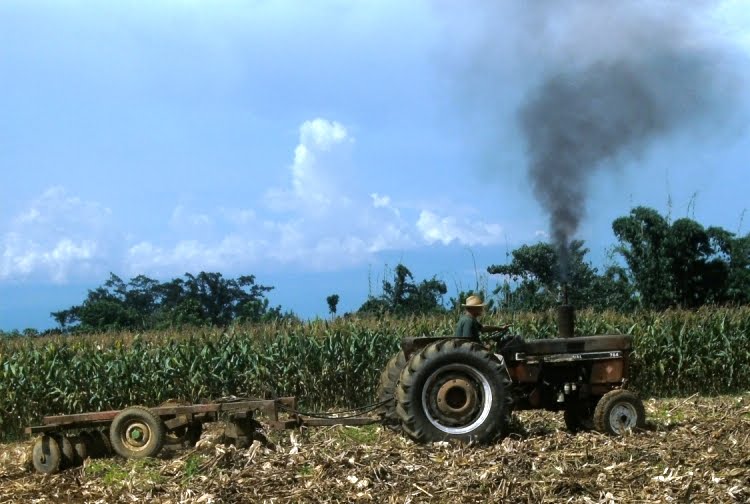
Making money from growing field corn is the essence of the term oxymoron. The fertilizer companies, the seed companies, the corn buyers, and the banks that often finance all of this activity, they all make money. But the farmers that I observe around here usually operate at a net loss when it comes to this crop. And this is exactly the same scenario for farmers in the U.S. In fact, most of the very same multi-national corporations that American farmers do business with are here in the Philippines as well as most other South-East Asian countries for the same profitable game. Monsanto, Bayer, Syngenta, Dow, etc. all have offices and sales reps throughout the area. It’s sort of like they know a great way to make easy bucks season after season, so they just have to duplicate their operations wherever farmers are still out in the sun and soil struggling to make a living. 

Saturday, August 28, 2010

Are We Farming Yet?

November 2008

Every morning at 5 am, I'm out pasturing the baca. Since my very first early morning here last year, all of the mornings here seem to me truly glorious. The fireflies have already gone to wherever it is they go during the day, and now there's heavy dew on all the grass where crickets chirp softly to the sun coming up amidst the parting pinkish clouds and dormant volcanoes to the east.
At this latitude here in the Philippines, it doesn't matter if it's the day before Christmas or the middle of July, in one hour the sun will be coming up. I have only a vague concept of what it's like for the days to be the same length all your life, as Edna and her family have no concept of what the short, bitter-cold days of winter and extra-long and hot days of summer are like where I came from in Idaho. Edna and I decided that I should get up early every morning to take her dad's cattle out to pasture to relieve her mother of the chore.


He's been too disabled by his weakened heart to do it himself, so he wakes up his wife to make her do it. At 70, she's within spitting distance of her expected life span for women here; besides that her cataracts are so bad that we're not sure if she'd see a stone, a stick or one of the ten-foot-long crab-grass runners that are always tripping those of us with much better eyesight. There are only a few cattle to stake out somewhere in an area of fresh grass; there's also a 2 week old calf everyone is calling Bambi who gallops all about, seemingly ecstatic at the chance to be out in the world for another day's promise of adventure and discovery.

 Tink, tink, tink. Another stake is driven into the plowed soil with the head of my hand-forged axe, marking off one more of the 2000 holes to be planted in the coming days with young banana plants.


It's so very peaceful out here in these fields where now only two coconut palms are growing, surrounded by the pineapple fields of the Del Monte corporation; quiet, with only the wind, a few birds and a stray cricket adding to the music of the spheres that seems to be audible.
I'm always enraptured by the vista from this field, with the nation's second-highest mountain jutting up from the plain just to the South, along with its accompanying range of fantastic, remote and forested peaks marching right behind. In the few kilometers of plain before the mountain range abruptly makes its presence, there other farms and villages along roads I've not yet explored. And to the East there is an even greater mountain range; not higher, but broader and taking up much more of the landscape. On the road that passes around those far-off peaks is the way to Malaybalay, the provincial capitol, another region I have yet to investigate.
Once we make our first harvest from these bananas in about fourteen months, we hope to finance a motorcycle and I've told Edna that explorations will begin in earnest.